
How to work through ‘that person is copying me’ syndrome as a creative

An honest guide for the moments when your brain goes to war with your fellow creatives.
We've all been there. You announce an idea, share a project you've been quietly nurturing, talk through your vision with a fellow creative. And then, seemingly out of nowhere, someone else appears to be doing the same thing. A similar project, a similar concept or similar aesthetic. And then the tidal wave of thoughts start...
They copied me. They stole this from me. I was doing this first.
You’re not alone. And I say that not as a throwaway reassurance, but from lived experience: both as the person who has had those thoughts bubble up, and as the person on the receiving end of them. The creative world is small, ideas travel fast, and our egos are more fragile than we like to admit.
I'm not a psychologist. But I am a creative, and I believe this is deeply embedded in what I'd call the creative complex: that tangled web of passion, insecurity, comparison, and ego that comes with putting your work and your vision into the world. Here's what I've learned about working through it, the hard way.
In this post:
Think carefully about what you're actually trying to achieve
If you're going to say something, leave the legal language out of it
A note before we begin
I want to share something personal, because I think context matters here.
When I began putting out feelers for my project Soulskin (a body of work exploring the return to the wild self in motherhood) I reached out on Instagram for mothers to photograph. Within minutes of posting that story, I received a long, accusatory text message from another creative. She questioned my intentions, made a series of assumptions that were neither true nor accurate, and used the words intellectual property to describe what she felt I was infringing upon.
To be clear: photographing mothers is not anyone's intellectual property.
But beyond the legal absurdity of it, the timing was devastating. My creative fire had only just returned after working through postnatal depression. Not the baby blues, but the actual, clinical, life-altering kind. I was in the most tender place I'd been in years. And this message landed like a wrecking ball.
I felt like I was under personal attack. I felt like I had to explain and justify my project to the world before it had even truly begun. I worked through the fallout with three therapists, three people who were needed to hold this mama together. The person who sent that message knew what I'd been through, and hit send anyway.
I share this not to bring back the pain of it, nor as a way to embarrass this person, but because it's the reason I believe this topic needs honest conversation. These thoughts, when acted upon without care, can cause serious harm. So let's talk about how to work through them before they leave your hands.
1. Approach with compassion first
Before you do anything, pause and ask yourself: how would that other person feel if I said this out loud to them right now?
I always try to imagine the actual conversation. Picture the expression on their face as you say the words: "You copied my idea." Think about what happens to the room, to the friendship, to the energy between you. Then ask yourself: is this worth it? What am I actually trying to achieve here?
When I received that message, I didn't feel challenged. I felt attacked. My creative spirit, the one I had been so carefully, quietly coaxing back into the world, was blundered. And because of how it landed, I didn't feel motivated to reassure the sender or meet her in any kind of understanding. I felt like retreating entirely.
Compassion isn't weakness. It's the most powerful thing you can lead with, especially in creative communities where we all need each other more than we realise.
2. Journal it. Don't send it.
This is the rule I wish someone had handed me as a laminated card the moment I chose the creative path in life.
Write it all down. Every accusation, every angry thought, every "I KNOW they saw my work and used it." Get it out of your body and onto a page. A page that only you will ever see. Don't draft the message. Don't type out the text. Don't begin the email. Journal it first.
Then, if you still feel strongly after the heat has passed, talk it through with someone you deeply trust: a best friend, a partner, a therapist. Someone who will be honest with you, not just validate your feelings. You need someone who will gently ask: but are you sure? What do you actually know to be true?
That filter (time and a trusted person) is everything. It has saved me from sending things I would have deeply regretted. It may save a friendship. It may save someone else's mental health.
3. Stay in your lane
I think about my third year at uni. Stakes were high, everyone was pushing into their most ambitious work, and suddenly the murmurings started - "did you see what she's doing, that's literally my idea." It was everywhere. But the people who got lost in that noise? They lost time. The ones who kept their heads down and stayed absorbed in their own concepts came out with the strongest work. I was in my own little world back then, sparked by my own references and rabbit holes, and I'm so glad I was. Nobody can follow you into your own imagination.

‘Stay in your lane’ was a phrase I actually received during that difficult time I mentioned previously. And even though it wasn't aimed at me, I found myself quietly nodding along. Because it's true, and it applies to all of us.
When we're focused on what someone else is doing, we are not focused on our own work. We’re leaking energy that belongs to our creative process into a story that may not even be real. Every minute spent monitoring someone else's output, comparing it to ours, building a case in our heads: that is a minute stolen from the work that only we can make.
Your voice, your lens, your specific combination of experiences and perspectives? Nobody else has that. Nobody can copy that, even if they tried. So come back to your lane. Come back to your work. That's where the magic is.
4. No idea is truly original, and that's actually beautiful
This one stings a little, but it's worth sitting with.
Ideas are in the air. They float. They land on multiple people at once, often because those people are responding to the same cultural moment, the same collective feeling, the same gap in the world. You have almost certainly had an idea that you were certain was original… and then found it already existed in some form. We all have.
This doesn't diminish your idea. It actually affirms it. It means you’re tuned in, your instincts are sharp enough to pick up on something real. And it means that the way you execute your version of that idea (your unique angle, your specific story, your irreplaceable perspective) is what will make it yours.
Two people can photograph mothers. Two people can write about grief, or joy, or the body, or belonging. The world isn't diminished by both of them existing. It's richer for it.
5. Think carefully about what you're actually trying to achieve
Flip the feeling around for a moment. Instead of sitting in the wound of ‘they copied me’, ask yourself: what does my version of this work actually mean to me? What am I trying to say with it? Who am I making it for?
When you reconnect with the heart of your own project, something shifts. You remember that your work isn't fragile. It isn't diminished by someone else also making something. Your project is yours because of the specific journey behind it, the intention inside it, the way only you will bring it to life.
This step is also a good litmus test. If thinking about what your work truly means to you feels harder than building the case against someone else, that's worth noticing. That's the insecurity talking. And that's okay. It just means there's something worth tending to in yourself, not something worth pursuing with (or projecting onto!) someone else.
6. If you're going to say something, leave the legal language out of it (unless you've actually spoken to a lawyer)
If, after all of this reflection and journalling and trusted-friend vetting, you still feel that a real conversation needs to happen, then have it with warmth and openness, not accusations.
And please, unless you have actually consulted a legal professional and they have confirmed that your intellectual property has been genuinely infringed, do not use that language. The words intellectual property and legal action are grenades. Once you throw them, you cannot un-throw them. They reframe the entire relationship, and rarely in a way that serves anyone.
Come from curiosity first. "I noticed we seem to be working on something similar, I'd love to chat about it." That opens a door. An accusation slams one shut.
7. Be the inspiration
This is my favourite shift, and the one that takes the most practice.
When I was working at a startup tech company, we came up with this rad design system that was entirely unlike anyone in our space was doing. Another company ripped it off, geometric by geometric. The CEO was a bit salty about it and I was like - this is awesome. We should be so flattered they are copying us. We're already moving onto our next iteration anyway. Theirs looks dated. That's what copying does. It freezes you in someone else's past. Originality keeps moving.
What if, instead of feeling threatened, you chose to feel flattered? What if someone moving in a similar creative direction to you is actually evidence of your influence, your relevance, your ideas having weight in the world?

Here's something worth holding onto: copying is not sustainable, but originality is. People can feel when something has come from your heart. They always can. You cannot replicate that, no matter how closely you follow someone else's blueprint. So the best thing you can do is keep going deeper into your own work, your own voice, your own why. That's what lasts.
Be the one who lifts. Be the one who reaches out to the other creative and says, "I love what you're making." Be the one who builds community instead of competition. Because the creatives who are remembered, the ones whose work lasts and whose impact compounds, are almost never the ones who hoarded their ideas. They're the ones who shared generously, led with integrity, and made the whole space feel bigger and more possible for everyone in it.
That's the creative you want to be. I know it's the creative I'm always reaching toward.
A book recommendation on the subject
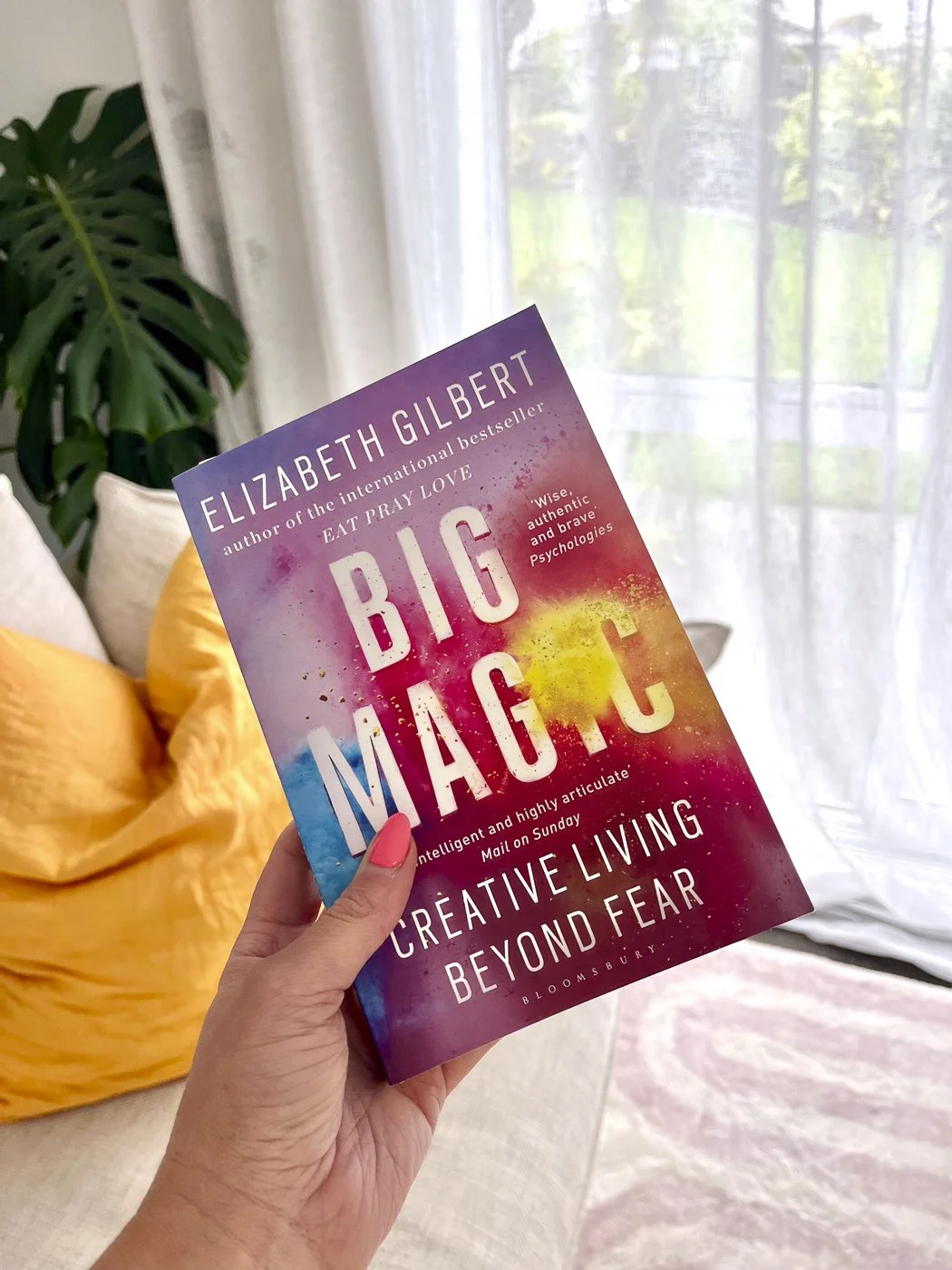
If this topic has resonated, and especially if you've ever wrestled with the fear that your ideas aren't original enough, or that someone else is doing it better, or that creativity is some finite resource you have to fight for, please read ‘Big Magic’ by Elizabeth Gilbert.
It’s one of the most liberating books I’ve ever read about the creative process. Gilbert writes about ideas as living things, about fear and creativity coexisting, and about what it really means to make something in the world. It reframed so much of how I think about creative ownership, inspiration, and what it means to show up for your work.

FAQs: creative copying and idea ownership
Is it stealing if someone has a similar creative idea to me?
Not necessarily. Ideas are in the air and land on multiple people at once, especially when creatives are responding to the same cultural moment. Having a similar idea to someone else doesn't make either of you a thief. What makes your work yours is how you execute it.
What should I do if I think someone copied my work?
Journal it before you do anything else. Get it out of your body and onto a page, talk it through with someone you trust, and give yourself time before you act. If you still feel strongly, approach the conversation with curiosity and warmth rather than accusations.
Can I take legal action if someone copies my creative idea?
An idea on its own is very rarely protected by intellectual property law. If you believe your actual work (not the concept, but the specific execution) has been genuinely infringed, speak to a legal professional before using any legal language with the other person.
Why do creatives feel like others are copying them?
It usually comes from insecurity rather than reality. When we're deeply invested in our work, we become hyper-aware of anyone in a similar space. That sensitivity is worth examining honestly before acting on it.
That’s a wrap
I've had this post sitting in my drafts for a couple of years. And I think that's because, for me, every piece of writing I put out from the heart is the final step of processing. It's how I digest the hard stuff, put it down, and move on. This one is for the creatives who need it. And to be totally honest, it's for me too.
To the creatives reading this who have been on either side of this experience: you are not alone, and you are not a bad person. We’re all just figuring out how to hold our most tender, most alive parts out in the open. Be gentle with yourself and be gentle with each other.